
Have you ever looked at your daily setup and realized you didn't actually pick it? For many of us, the tools we use every day aren't the result of a long, exhaustive research phase. Instead, they're the ones we were handed on day one of our learning programs or the ones our favorite teacher swore by. This inherited tech stack becomes our comfort zone, but it can also start to feel like a bit of a cage if we aren't careful.
It's a common story in the dev world. You learn Java because your university curriculum demanded it, or you stick with PHP because that's what the local agency used when you started. Before you know it, five years have passed and you're a wizard in that specific ecosystem. There's a lot of beauty in that kind of deep knowledge, but there's also a nagging voice wondering if you're falling behind.
Let's chat about how to embrace what you've inherited without letting it stall your career.
The Secret Power of Deep Expertise
There's a massive trend in tech to "stack hop" every time a new framework hits the front page of Hacker News. While being a generalist has its perks, having an inherited tech stack gives you something many devs lack: true depth.
When you've lived in a stack for years, you aren't just writing code. You're navigating the nuances of its garbage collection, understanding how it handles concurrency, and knowing exactly which library is going to break when you update a minor version. This kind of "institutional memory" makes you incredibly valuable. You can solve complex architectural problems because the syntax is second nature.
However, as I mentioned in my post about Things I Googled This Week, even experts forget the basics. The key isn't just knowing the stack, it's knowing how to keep your foundation solid while the world moves around you.
Don't Let Your Tools Define Your Thinking
The biggest risk of staying with what you were taught is the Golden Hammer effect. If you've only ever worked with a relational database, every data problem starts to look like a table. If you've only ever used object-oriented programming, every logic flow looks like a class hierarchy.
To keep your inherited tech stack from becoming a limitation, you've got to supplement it with outside ideas. You don't have to switch languages to learn about:
- Functional Programming: Even if you're in C# or Java, you can apply immutability and pure functions.
- Serverless Architectures: You can often deploy your "old school" backend in a modern, event-driven way.
- Clean Architecture: This is the big one. Decoupling your business logic from your framework makes your code timeless.
Sometimes, trying to force an old tool to do a new trick can lead to issues. I’ve seen this firsthand when I spent 8 hours proving I was wrong about a specific infrastructure choice. It’s a humbling reminder that our "tried and true" methods need a reality check every now and then.
Modernizing From Within
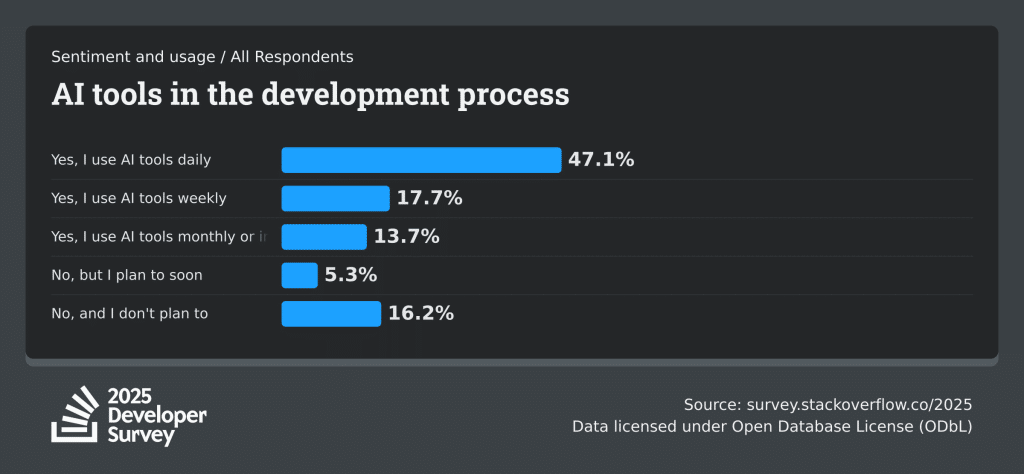
If you feel stuck in an inherited tech stack, you don't need to quit your job to feel "modern" again. Start by bringing current industry standards into your existing workflow. According to the 2025 Stack Overflow Developer Survey, more than 80% of developers are now integrating AI tools into their daily routines. You can use these tools to bridge the gap between your legacy knowledge and modern patterns.
Apply SOLID principles to your existing codebase. Refactor that giant controller into smaller, testable services. By focusing on the quality of the code rather than the "trendiness" of the language, you’re building skills that are completely transferable. Remember that the hidden costs of simple features often come from poor architecture, not the language itself.
When Is It Time to Let Go?
It’s okay to stick with your inherited tech stack as long as it’s still solving problems effectively. But keep an eye out for these red flags:
- The community is shrinking and finding documentation is getting harder.
- You're spending more time on "hacks" to make modern integrations work than on actual features.
- Your stack is actively preventing you from implementing necessary security or performance updates.
If you hit those walls, it isn't a betrayal of your roots to move on. It's just the next step in your evolution.
I'd love to hear about your experience! Are you still using the first language you ever learned, or have you made a clean break? Drop a comment below or join the conversation over on my Twitter. Let's keep building better, no matter what tools we started with!